30-day satisfaction guarantee or your money back
Call us : +33 257 880 074
 en
en 









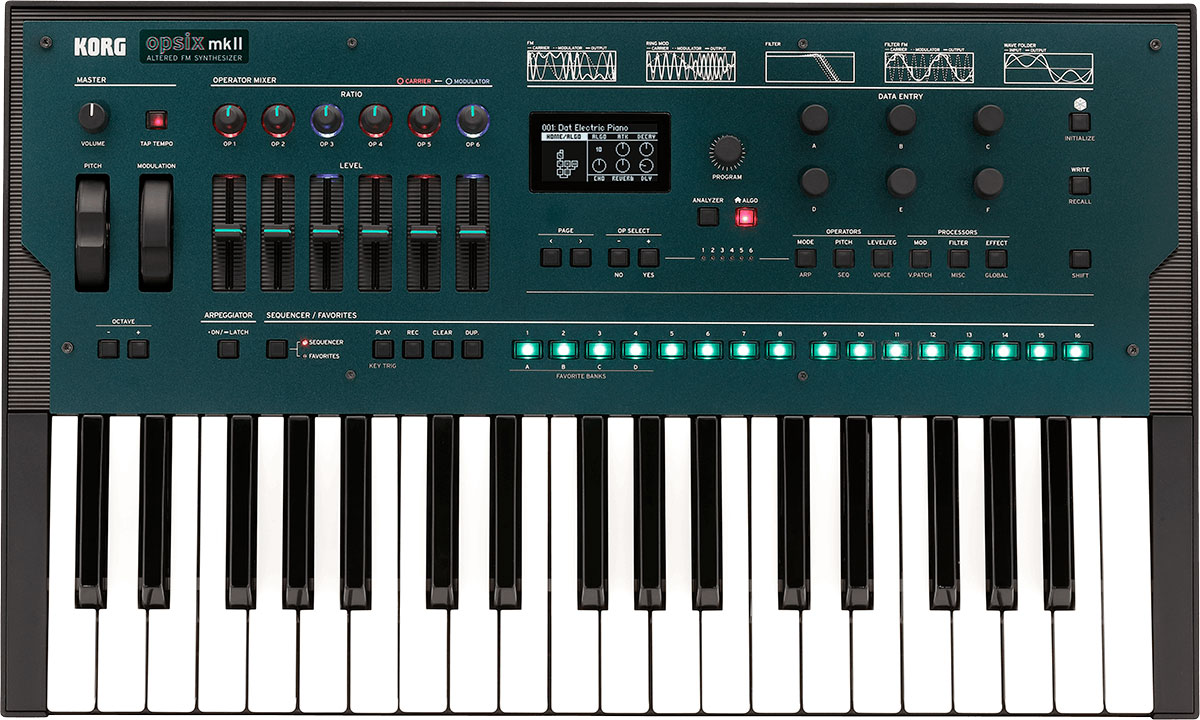


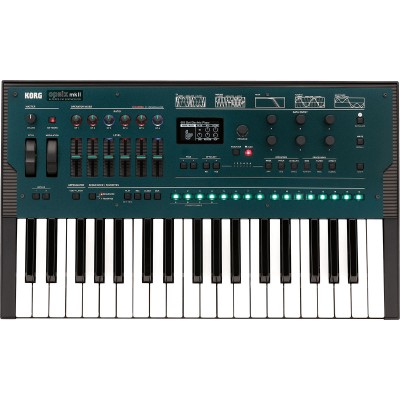
The KORG opsix mk II builds on the sound engine that made the original opsix so accessible, pushing it further with polyphony increased to 64 voices and more simultaneous voicings. It retains the "simplified FM" philosophy thanks to the Operator Mixer, and remains compatible with sounds and samples from the original opsix as well as the opsix Native software, including numerous high-quality libraries. The Operator Mixer section, a visual and sonic signature of the series, comes here with a revamped design featuring a green identity.
The opsix mk II is aimed at curious beginners as well as experienced sound designers who want to enjoy an inspiring digital synth without getting lost in traditional FM complexity. Perfect for techno, electro, ambient, synthwave, pop, or film scoring, it excels both in the studio (textures, pads, bells, basses, expressive leads) and live thanks to its direct controls and "hands-on" approach.
At the heart of the opsix mk II, 6-operator FM synthesis becomes an immediate playground: the Operator Mixer literally puts the FM structure at your fingertips, with illuminated indicators for carriers and modulators so you instantly understand what you hear. To go beyond classic FM, the "altered FM" architecture multiplies creative paths: routing reorganization in the Algorithm section (no cables), waveshaping for biting harmonics, stacking for additive approaches, and an "analog" aesthetic via dedicated controls and multi-modeled filters.
The workflow is enhanced by a large OLED screen combined with quick-access controls, as well as integrated visual tools (spectrum analyzer and oscilloscope) to keep control over energy and timbre. On the production side, three effect blocks (30 types total) can be used simultaneously to move from subtle chorus to shimmering reverbs. Finally, the polyphonic step sequencer allows recording up to six notes per step, adjusting velocity, time, gate, and timing, and animating sound via motion sequencing recording up to six parameters. Need inspiration? The Randomize function generates new patches, across the entire program or by sections (operators, algorithm, sequences).