30-day satisfaction guarantee or your money back
Call us : +33 257 880 074
 en
en 









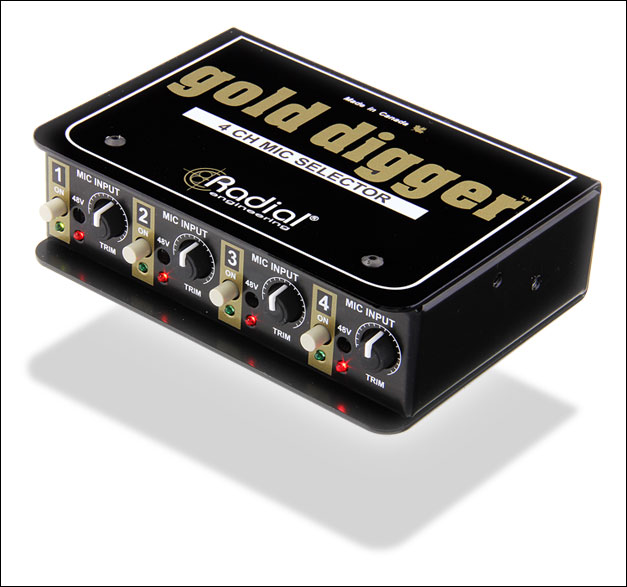


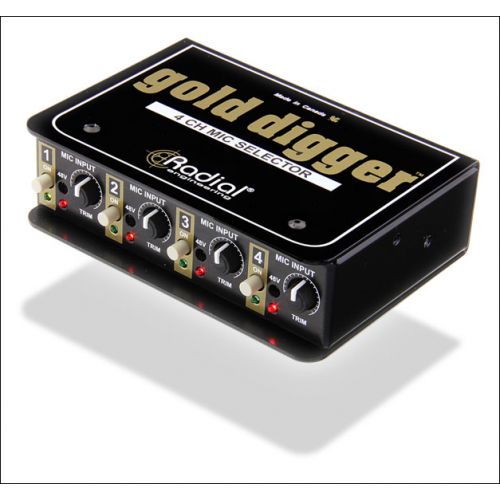
Comparing microphones is often more complicated than it seems: as soon as you change preamps, settings, or even load, perception shifts and you no longer know what you are truly evaluating. The Gold Digger belongs to the family of high-end "utility" tools dedicated to the recording studio: it centralizes microphone selection and allows switching from one to another in seconds, while keeping exactly the same downstream chain. The result: you judge the microphone, not the rest of the setup.
The Gold Digger is primarily aimed at sound engineers, producers, and studios who want to speed up sessions while gaining reliability in microphone choice. It is particularly relevant for vocal recordings (singing, voice-over, podcast) where hesitation exists between several models, but also for sources like acoustic guitar, amp, room, percussion, or brass, whenever a quick comparison is needed.
In practice, the benefit is twofold: on one hand, you improve your workflow (less unplugging, fewer trips to the booth), on the other, you build the artist's confidence. Being able to immediately hear "how the voice sounds" on several microphones, at equal level, helps validate a choice and encourages better performance from the first takes.
The Gold Digger adopts a passive design without audio buffer or transformer. Switching is done via military-grade relays with gold contacts, chosen for their reliability and ability to preserve signal integrity. The goal is clear: to guarantee switching from one microphone to another without coloration, distortion, or artifacts, so that the perceived difference comes solely from the microphones.
Each channel features a "radio" type selector: when you activate one, the others are automatically excluded. This logic prevents accidental mixing, limits the risk of interference between microphones, and ensures the operator that only one microphone feeds the preamp at a time. This is an essential detail when seeking to finely compare low-end response, presence, air, or how a microphone handles transients.
The external power supply handles LEDs, relay activation, and allows the Gold Digger to generate its own 48V phantom power. Activation can be done microphone by microphone, simplifying management of hybrid configurations (for example, a dynamic alongside two condensers and an active ribbon), while maintaining direct control over each input.
To ensure truly impartial comparison, the Gold Digger includes volume compensation controls: you adjust each input to achieve identical relative output. This is crucial because a slight level difference can create the illusion that a microphone "sounds better" simply because it is louder. Once levels are aligned, you can focus on the criteria that matter: timbre, definition, sibilance, depth, and placement in the mix.