30-day satisfaction guarantee or your money back
Call us : +33 257 880 074
 en
en 









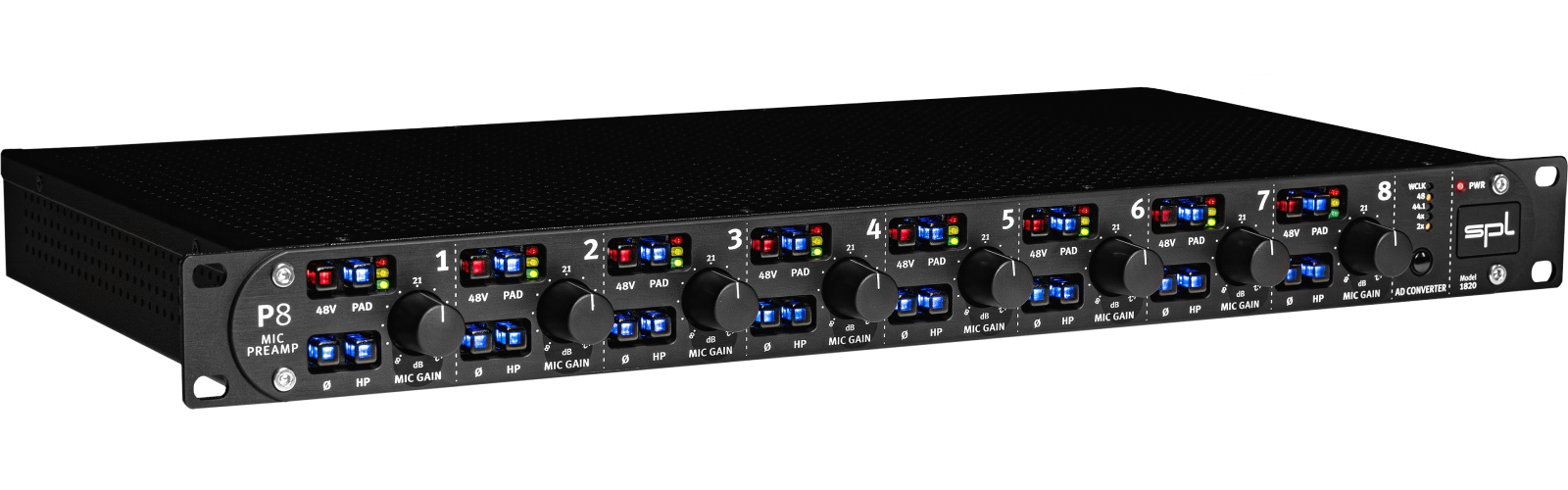


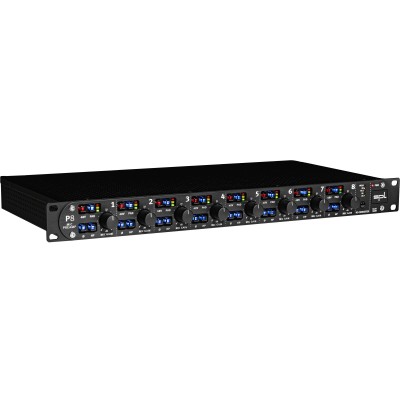
The P8 follows a simple philosophy: offering eight strictly analog channels built around a discrete design with individual transistors. This design choice, typical of high-end studio equipment, aims to provide microphone amplification that is stable, musical, and precise, with an immediate dynamic feel. While some multichannel preamps prioritize integration and compactness through integrated circuits, the P8 emphasizes a more "audiophile" architecture, designed to preserve the naturalness of transients and signal clarity, even when sessions become dense.
Another key point: the P8 deliberately remains purely analog in its operation. If you want to integrate it into a digital production workflow, adding an optional 8-channel ADAT converter allows you to connect it to an audio interface via a digital link, while maintaining the character and coherence of the eight upstream channels.
The P8 is particularly suited if you regularly record multiple simultaneous sources and want consistent quality across all channels. It excels in recording drums (overheads, toms, snare, room), live bands, acoustic sections (strings, brass), as well as choirs and multiple vocal takes. Thanks to its per-channel settings, it adapts equally well to condenser microphones requiring 48 V phantom power as well as dynamic and ribbon mics (with the usual care regarding phantom power).
In advanced home studios, it is an excellent way to step up your multitrack recordings: instead of relying on heterogeneous preamps, you have a coherent unit optimized to deliver a clean and usable signal for mixing. In professional or mobile studios, the P8 becomes a reliable tool to ensure high-quality multichannel captures with direct and immediate control.
Each channel features analog gain control to adjust preamplification as close as possible to the source and microphone used. The discrete design (individual transistors) contributes to a sense of definition and depth, with an extended response that helps preserve the air of the recordings and the precision of attacks. This approach is especially appreciated on transients (percussion, acoustic guitar, piano) and on recordings where a clear image without harshness is sought.
In sessions, good habits save mixing time. The -20 dB PAD allows handling high levels (close sources, sensitive microphones, percussion) without saturating the input stage. The phase inversion helps quickly correct coherence issues between multiple microphones (overheads and snare, stereo pair, ambient mic). Finally, the analog high-pass filter (6 dB per octave at 80 Hz) is used to clean handling noise, stage hiss, vibrations, and proximity effect, while maintaining a controlled low end.
Each channel offers individually switchable 48 V phantom power. This is a real advantage in hybrid setups when mixing condensers and dynamics in the same session. You maintain fine control, channel by channel, without compromise, and safeguard your setup by activating phantom power only where it is needed.