30-day satisfaction guarantee or your money back
Call us : +33 257 880 074
 en
en 









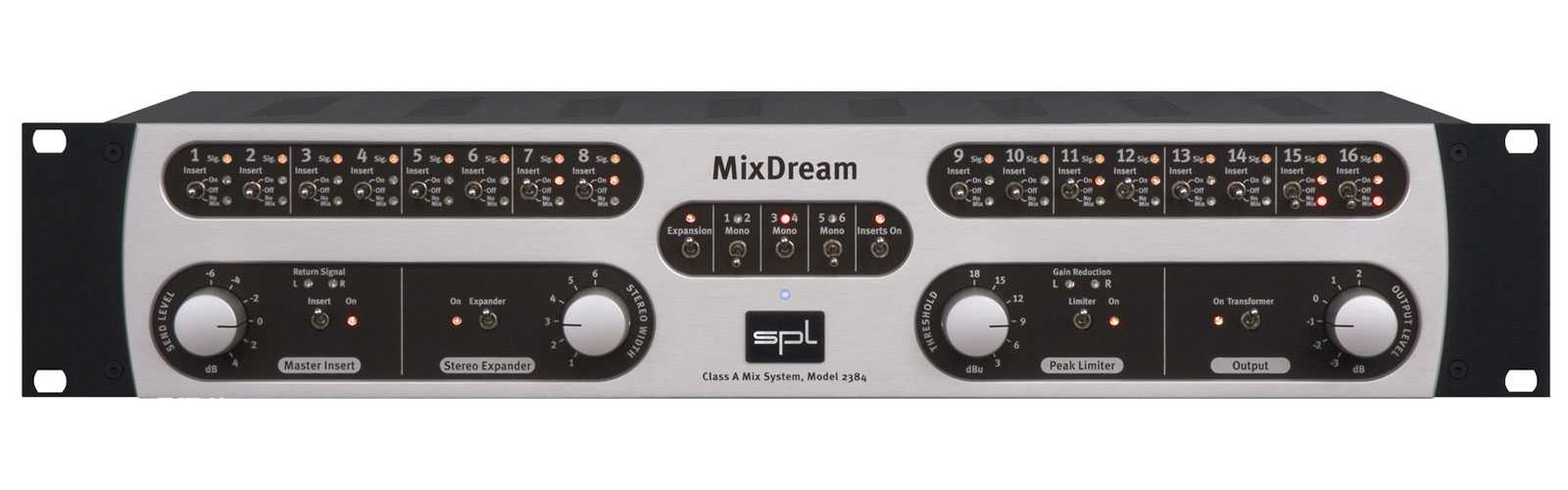


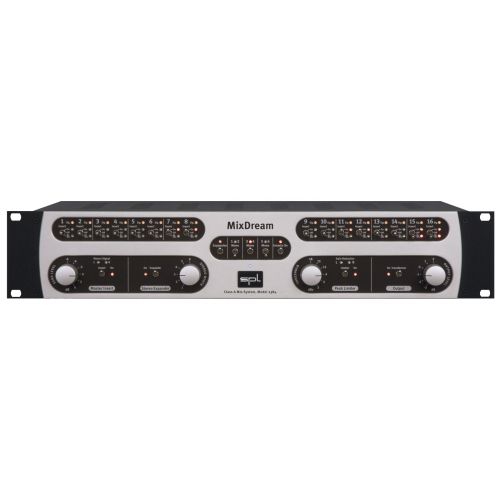
The MixDream was designed to address a very current studio reality: mixing "in the DAW" while regaining the density, depth, and spatial feel of an analog bus, without sacrificing automation convenience. Rather than imposing level and pan controls on the front panel, SPL opts for an architecture that leaves these parameters to the DAW, while entrusting the summing of signals and integration of external processing to dedicated analog electronics.
In this logic, the MixDream is not limited to "summing": it emphasizes a crucial aspect of mixing, namely the quality and simplicity of integrating analog processing during the session. This chain (summing + inserts + stereo bus) enables building a coherent hybrid workflow, close to that of a console but adapted to modern conversion constraints.
The MixDream is aimed at sound engineers, producers, and studios who want to externalize the mix bus and utilize their analog processors (compressors, equalizers, saturation, multi-effects) while retaining the editing precision, session recall, and automation of a DAW. It is suitable for music mixing (pop, rock, electro, hip-hop) as well as projects requiring a very stable stereo image and precise source localization.
It can also find its place in a mastering or stereo processing approach, and in multichannel configurations, with the possibility to expand by chaining multiple units.
The MixDream sums up to 16 tracks into an analog stereo signal, with the possibility to sum more channels by linking multiple units. Each input features a presence LED and a switchable insert loop, allowing insertion of external processing on a specific channel or keeping a completely clean chain depending on the mix needs.
Relay switching and optimized signal paths contribute to reliable daily integration, whether working in tracking, production, or final mix.
The No-Mix function allows removing a channel from the summing bus while keeping it available for re-recording via its direct output. In practice, this is a very effective tool to process a track in analog (e.g., compression) then send it back into the DAW to benefit from level automation afterward, without the compressor being "after" the automation. This method, often called "bounce back," becomes simple to implement and neatly routed.
The MixDream helps to reduce the number of conversions during hybrid mixing, especially when inserts are used: instead of multiplying A/D and D/A conversions for each processing, the idea is to process analog in the analog domain and only reconvert the summed signal when relevant. The result is a more direct workflow and a chain where sensitive conversions (notably D/A) can be limited to the strict minimum.
To further optimize converter channel usage, a mono mode allows switching certain pairs (1 and 2, 3 and 4, 5 and 6) to mono to group two signals for grouped D/A conversion. This approach is particularly suited to often centered elements (kick drum, snare, lead vocals, bass) and contributes to more rational converter output management.
The stereo section provides finishing tools directly on the mix bus: adjustable insert level, continuous stereo expansion to widen the image with finesse, and an adjustable analog peak limiter to control transients. The switchable Lundahl output transformers offer an additional choice of character and adaptation to the rest of the chain (converters, monitoring, recorder).
Beyond tracks from the DAW, the MixDream facilitates connecting external sources (samplers, keyboards, expanders) and integrating them into the analog mix via the insert loops. Finally, the architecture allows expansion of the number of channels by chaining, and use in surround with up to three linked units.