30-day satisfaction guarantee or your money back
Call us : +33 257 880 074
 en
en 









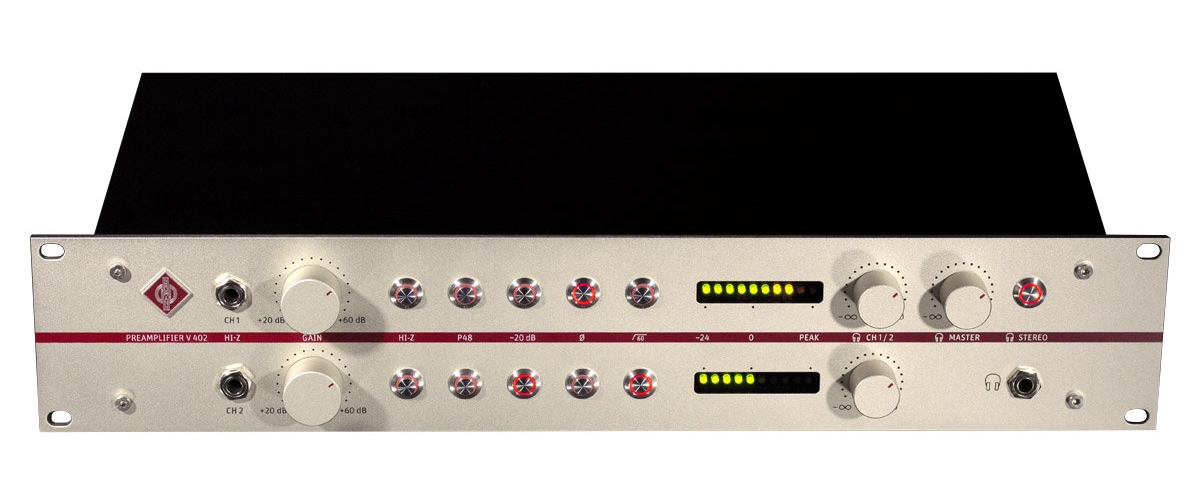


The V 402 marks an important milestone in Neumann's recent history: it is the brand's first microphone preamplifier since the launch of the V 476b in the 1980s, which became a reference in many professional studios. Rather than "reinventing" a sound, Neumann relies here on decades of demanding standards around capture: the idea is simple yet ambitious-to offer a preamplifier capable of preserving the full signature of a microphone, whether it is a current Neumann model, a vintage classic, or another very high-quality studio microphone.
In this spirit, the V 402 positions itself as a contemporary preamplification tool, developed with modern measurement methods and thorough listening tests. The goal is not to impose a "signature" but to deliver amplification of great purity, consistent at all gain levels, in order to maintain the spectral balance, dynamics, and depth of field that define the value of a good recording.
The V 402 is aimed at recording studios, sound engineers, and producers seeking a transparent preamplifier for vocals, acoustic instruments, ambient recordings, and any source where transient finesse and micro-dynamics are essential. It is particularly suitable for users already working with high-end microphones who want to avoid the "veil" effect that some preamps can introduce at high gain, especially on delicate takes (intimate vocals, strings, piano, detailed percussion).
Thanks to its DI inputs, the V 402 is also a solid choice for direct recording of bass and guitar, or electronic instruments: the very high input impedance helps preserve attack, brightness, and presence while limiting audible noise. In a modern production context, it can become a truly versatile recording hub: two channels for stereo recording, vocal/instrument duos, or main vocal chain + DI, with precise headphone monitoring and intuitive monitoring control.
The V 402 is designed to achieve a high degree of linearity and sonic purity. Practically, it aims to amplify the signal without unwanted artifacts such as noise and distortion, and without artificially "rounding off" details. The benefit in the studio is immediate: you retain the microphone's original texture, the precision of attacks, and depth, while enjoying a controlled output level. This consistency across the entire gain range is particularly valuable when chaining multiple takes or alternating between very different sources during a session.
The two DI inputs follow the same philosophy: preserving sound and nuances without loss of definition. Very high input impedance and carefully designed circuits allow capturing an "open" direct signal, useful for a dynamically played bass, guitars with clear attacks, or keyboards and machines where transient precision is desired. The expected result is a bright, clean, and usable signal, ready for further processing (amplification, simulation, compression, saturation) without having already undergone imposed coloration.
The V 402 includes a switchable 20 dB attenuator to confidently handle high-level sources up to 28 dBu without distortion. This is a real advantage when working with percussive signals, high line outputs, or close-miking that generates significant levels. The high-pass (low-cut) function has been developed to effectively remove rumble, handling noise, and vibrations while avoiding degradation of the useful signal: the goal is to clean up the recording at the source without losing the body of the voice or the harmonic foundation of an instrument.
For recording sessions, the V 402 focuses on clear and detailed headphone listening, and a simple-to-adjust control mix thanks to a volume control for each channel. This monitoring comfort allows working quickly, validating balances during tracking, and securing decisions (microphone placement, gain level, high-pass activation) without struggling with complex routing.