30-day satisfaction guarantee or your money back
Call us : +33 257 880 074
 en
en 









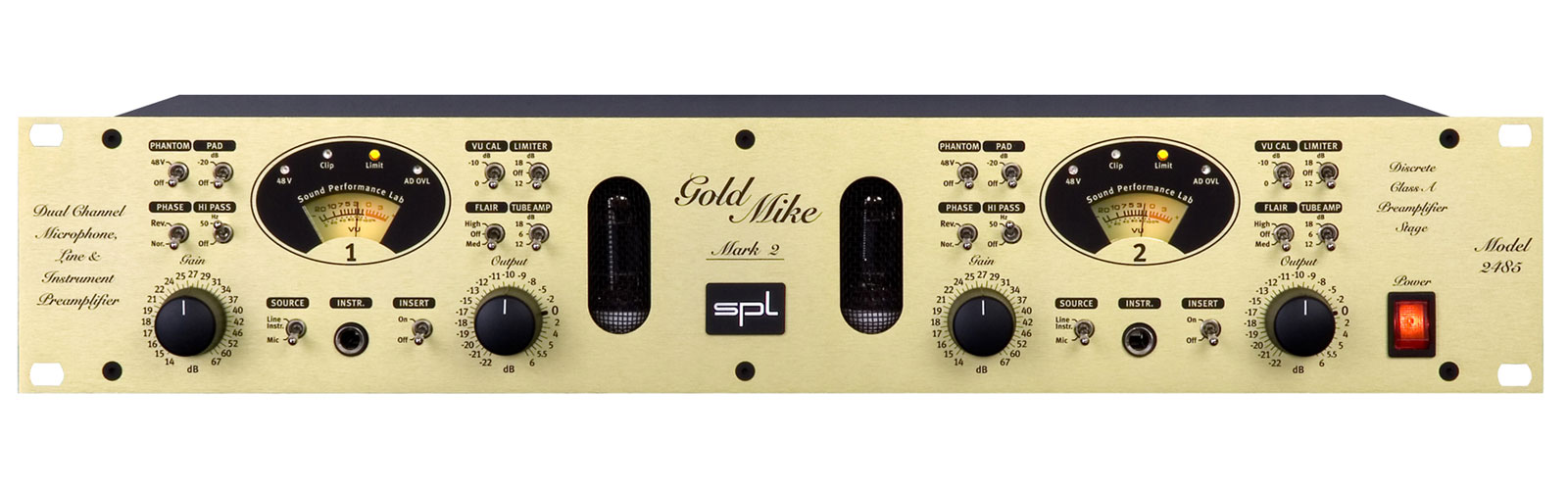


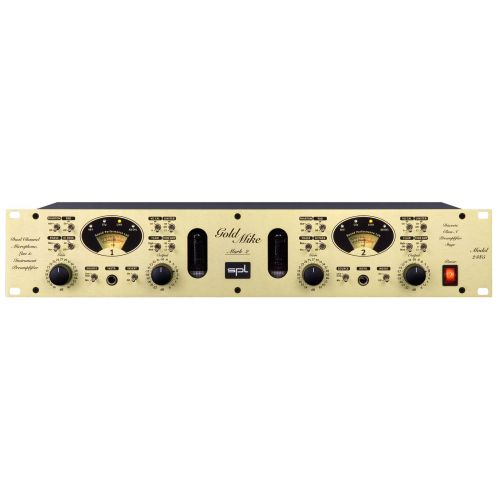
Following the legacy of the GoldMike 9844, the GoldMike mk2 carries forward the concept that made the original model successful: a hybrid microphone preamp capable of delivering a true analog signature while remaining versatile for everyday use. The major difference lies in the evolution of the transistor stage, now based on a discrete Class A architecture (without integrated circuits), and the tube stage which becomes adjustable to switch from very faithful capture to more pronounced coloration. The result: a preamp designed to meet demands usually associated with much more expensive equipment, while remaining simple to use in the studio.
The GoldMike mk2 is aimed at sound engineers, musicians, and creators who want a studio microphone preamplifier capable of adapting to many transducers and recording contexts. Its hybrid architecture, both quiet and generous, makes it particularly comfortable when it comes to cleanly raising gain on delicate sources, including ribbon microphones with very low output levels. For vocals, acoustic instruments, percussion, or keyboards, it allows choosing between transparency, controlled presence, and analog grain, while maintaining excellent clarity in the mix.
The new transistor stage adopts a discrete Class A design: the circuit consists of individually optimized components for their role, and does not use integrated circuits. This approach aims for a more solid and spacious reproduction, with a frequency response that remains consistent regardless of gain. Its very high slew rate (over 200 V per microsecond) helps to cleanly amplify the briefest details and high frequencies, preserving the transients that give realism to recordings.
Another key point: for filtering DC voltage components, a servo circuit avoids the use of coupling capacitors. This limits unwanted high-pass effects that could weaken the low end as gain increases.
Where the previous version offered a more fixed approach, the GoldMike mk2 introduces a tube stage with selectable amplification. In the standard +6 dB mode, the tube remains in a "clean" zone to mainly preserve the airiness and openness typical of tubes. The +12 dB and +18 dB positions allow for more colored behavior, with increased saturation and limiting on high levels, shaping character even before mixing processing.
The tubes used are Sovtek 12AX7 LPS, selected after technical tests and listening comparisons, aiming for a good signal-to-noise ratio and a wide, clear sound image.
The Tube Amp circuit acts directly on the tube behavior: the higher the input level, the more pronounced the saturation. When used subtly or moderately, distortions remain barely audible while the limiting effect already appears, which can add density and stability to peaks. For this working logic, the +12 dB position is particularly relevant to avoid excessively pushing the gain.
At +18 dB, saturation becomes clearly audible and distortions increase on high levels. The strength of the system is its handling: the intensity of the processing is controlled by the gain potentiometer, while the output level of the tube stage is automatically lowered to maintain an unchanged overall amplification. You can thus explore tube colors without losing your level references.
The GoldMike mk2 integrates the Flair mode, a sound optimization circuit inspired by the GoldMike 9844. Rather than functioning like a classic equalizer, Flair relies on the combination of coil filters and tubes to enhance presence naturally and discreetly. On vocals and acoustic instruments, the signal gains detail and intelligibility, with a sensation of better "forward placement" in the mix, which can reduce the need for further adjustments.
The treated band is wide (from 1.5 to 20 kHz around 6 kHz) and the boost is selectable: High or Med, with an Off position to disable the circuit.
The peak limiter uses diodes whose characteristic provides an analog saturation effect capable of elegantly and discreetly attenuating peaks. Thanks to its very high reaction speed, it is particularly effective at treating only peaks, making it a relevant protection before an analog-to-digital converter, even on very brief transients. It is especially useful on percussion instruments rich in peaks, while remaining usable on signals closer to a sine wave such as vocals and keyboards. To strongly increase the perceived volume of a signal, a conventional compressor or limiter will still be more suitable.