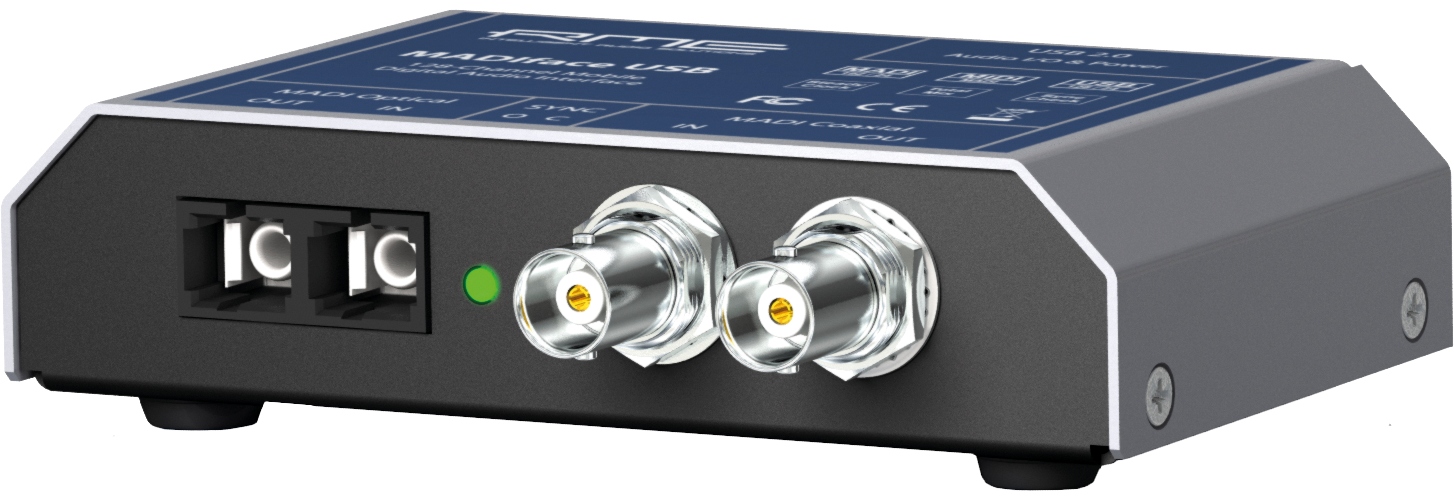
The essentials to know about the MADIface USB audio interface
- Up to 128 channels via USB 2.0 in an ultra-compact format: 64 input channels and 64 output channels in MADI format
- Dual MADI connectivity: 1 optical and 1 coaxial input and output to adapt to your equipment
- Internal routing and mixing with TotalMix to manage returns, sub-mixes, and signal distributions with great flexibility
- Designed for the field: rugged enclosure, bus-powered via USB, and standalone mode (repeater and format converter) with "Seamless Redundancy"
A compact MADI solution designed for ultra-portability via USB
The MADIface USB was designed to meet a very concrete need in studios and control rooms:
quickly connect a MADI environment to a Mac or PC computer while keeping a minimal footprint. Its desktop format and robust construction make it an easy interface to integrate into a fixed setup, but also practical enough for mobile configurations, recordings, and environments where reliability and simple cabling are prioritized.
Its positioning is clear: to offer an efficient MADI gateway via USB 2.0 without sacrificing essential functions expected in a professional workflow, such as routing, monitoring, and managing critical scenarios (for example,
redundancy).
Who is the MADIface USB for and in which uses does it excel?
The MADIface USB is aimed at users who already work with MADI equipment and want to
centralize or expand their inputs/outputs to a computer: multitrack studios, post-production, live, broadcast, venues, and conversion racks. MADI is particularly appreciated for transporting many audio channels over a single link, which simplifies architecture and reduces cable clutter when managing setups rich in sources or multiple headphone returns.
Specifically, it becomes an excellent option if you want to: integrate a MADI preamp/converter into a DAW, retrieve returns from a MADI console, create a compact recording station, or build a monitoring and signal distribution solution from a MADI stream. Thanks to USB bus power, it sets up quickly: ideal for sessions where you need to install, record, and pack up without complexity.
Key features: routing, standalone mode, and link security
TotalMix: a routing and monitoring core serving the workflow
With
TotalMix, the MADIface USB is not limited to just "getting channels in and out." You have a mixing and routing environment to organize your returns, create monitoring sub-mixes, distribute signals to different destinations, and structure your session more smoothly. This saves time daily, especially when switching between tracking, overdubs, studio listening, and control listening, while maintaining a coherent internal patch logic.
MADI optical and coaxial connectivity: integration flexibility
Offering
one optical and one coaxial MADI input and output simplifies integration into existing setups. Depending on your devices, you can favor one type of connection or organize your cabling to meet distance, accessibility, or compatibility constraints. This versatility is valuable when interfacing heterogeneous equipment (converter, stagebox, console, recorder, distribution).
Standalone mode: repeater and format converter
The MADIface USB can operate in
standalone mode, making it useful even without a computer. In this context, it can serve as a
repeater and
format converter, handy for securing a chain, troubleshooting a configuration, or adapting a link to available connectors. This is a real plus for environments requiring versatile solutions capable of fulfilling a precise technical role on demand.
"Seamless Redundancy": continuity and peace of mind
The presence of "
Seamless Redundancy" fits into a reliability logic: it aims to strengthen link continuity in sensitive configurations. In live, broadcast, or critical recording situations, this approach allows working more confidently, maintaining an architecture designed to limit interruptions caused by link issues.
Technical specifications
Audio and channels
- MADI audio interface via USB 2.0
- 128 channels in an ultra-compact enclosure
- 64 input channels
- 64 output channels
MADI connectivity
- 1 optical MADI input
- 1 optical MADI output
- 1 coaxial MADI input
- 1 coaxial MADI output
Routing and processing
Advanced features
- Standalone mode: repeater functionality
- Standalone mode: format converter
- "Seamless Redundancy"
Power and design
- Bus-powered via USB
- Compact and rugged design
 en
en