30-day satisfaction guarantee or your money back
Call us : +33 257 880 074
 en
en 









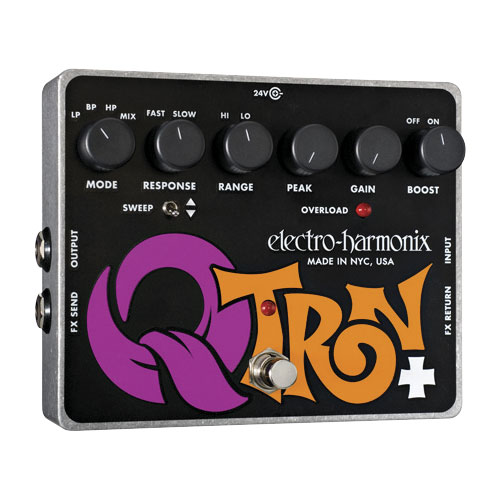


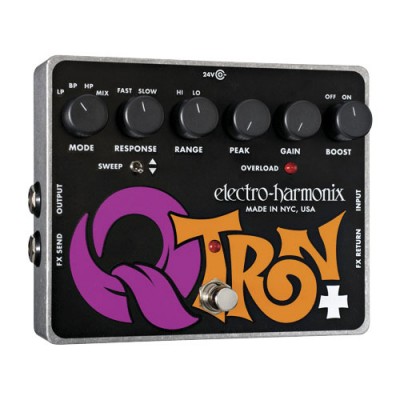
The Q-Tron Plus is part of the grand tradition of envelope filters that defined funk, fusion, and psychedelic textures. Its spirit clearly references the "touch sensitive" filters made famous by vintage circuits, with an Electro-Harmonix approach: more controls, more headroom, and a true modern pedalboard logic. Within the range, the Plus version stands out with two decisive additions for demanding musicians: a dedicated effects loop (placed at the optimal point in the internal chain) and a Response switch to choose the envelope's reaction speed.
The Q-Tron Plus is aimed at guitarists and bassists who want a lively, sensitive, and adjustable auto-wah without relying on an expression pedal. It excels in funk, soul, blues, rock, jam, fusion, and even more modern contexts (indie, electro, ambient) whenever rhythmic movement in the sound is sought. In the studio, it sculpts "speaking" attacks and highly articulated grooves; live, it delivers an immediately clear effect in the mix, especially on double-stop parts, chicken picking, or percussive bass lines.
If you play with marked dynamics (precise right hand, palm-muting, ghost notes), the envelope follower becomes a natural extension of your touch. And if your signal varies a lot (single-coil vs. humbuckers guitar, active bass, pickup changes), the gain and sweep range controls help maintain consistent triggering from one instrument to another.
At the heart of the Q-Tron Plus is the classic "preamp + filter" architecture: you first adjust the Gain to define how the envelope reacts to your attack, then shape the sweep character with filter type and frequency range selections. The mode selector offers Low Pass, Band Pass, and High Pass: three very different approaches, from thick roundness (LP) to a more nasal and percussive tone (BP), up to finer and sharper textures (HP).
The Peak (resonance/Q) control is key to shifting from a subtle, almost "hi-fi" effect to a very pronounced and expressive resonance. Add to that a direction switch (sweep up or down) to get either the typical rising "quack" or more enveloping, synthetic descents. Finally, the Boost provides extra energy to push the effect and achieve a more assertive behavior, useful when you want a filter that "speaks" even with light attacks.
The major signature of this version is the effects loop. It allows you to insert one or more pedals between the preamp (which feeds the envelope) and the filter section (which creates the movement). Practically, you can add distortion, an octaver, or delay in the loop while maintaining a stable envelope drive: ideal for preserving musical triggering even when the inserted effect compresses or squashes dynamics. It's also a formidable playground for creative chains (octave before filter, modulation after preamp, textured delays in the movement, etc.).
The Q-Tron Plus delivers an organic envelope filter sound, with a sweep that responds to nuances and intent. In fast mode, the attack is snappy and funky: the pedal "grabs" the note and immediately slaps, perfect for tight chicken picking and syncopated riffs. In slow mode, the movement becomes more fluid, almost vocal, with a sense of "shape" unfolding over the note: ideal for themes, floating intros, or round bass lines.
Depending on the Peak and sweep range (Hi/Lo) settings, you can go from a subtle filter that slightly animates the timbre to a dramatic, very present resonance that truly transforms your sound. This aesthetic has attracted renowned musicians known for their textures and grooves, including John Mayer, Flea, and Robert Trujillo, proving that the pedal fits both expressive contexts and more powerful productions.



 Verified