30-day satisfaction guarantee or your money back
Call us : +33 257 880 074
 en
en 











The Wake is part of the great history of chorus, an effect that became essential as soon as productions sought to widen a guitar (or bass) in the mix by adding movement, width, and depth. Rather than copying an analog chorus with its often very distinctive character, Catalinbread aims here for a more "studio" texture, inspired by the aesthetic of digital choruses and the 80s/90s atmospheres associated with dream pop and shoegaze sounds.
Its true signature is the integration of a mixable lower octave: a simple idea on paper, but formidable for giving the impression of a wider, deeper, and more present instrument without sacrificing musicality or note clarity.
The Catalinbread Wake is aimed equally at guitarists and bassists looking for an "additive" chorus, easy to dose, capable of blending into an already busy effects chain. If you have avoided chorus because "it sounds too much like an effect," the Wake is precisely designed to avoid this pitfall: it can become a grain foundation that makes a clean tone more lively, a crunch broader, and delays/reverbs more cinematic.
In terms of styles, it excels in dream pop, shoegaze, post-rock, indie, atmospheric pop, but it can also be used in funk/rock to thicken rhythms without drowning them. In the studio, the parallel octave is a quick tool to "fill out" an arrangement. Live, it gives the impression of a bigger sound, particularly effective in a trio or when a single guitar must occupy the space.
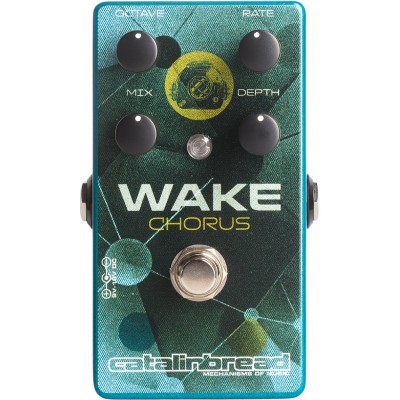
The Wake keeps it simple with four potentiometers, each covering a very musical range. The Rate control sets the modulation speed, from slow, misty movements to more nervous oscillations. The Depth controls the amplitude: from subtle thickening to deeper chorus waves, all while maintaining good note clarity thanks to the 8-voice architecture.
The Mix manages the balance between dry signal and chorus. At moderate settings, you get an integrated, natural chorus; pushed further, the Mix reveals colors close to vibrato, perfect for slightly unstable textures and very "record-ready" sounds. Finally, the Octave knob adds a lower octave in parallel: you can dose it as a discreet foundation beneath your sound or as a real reinforcement to thicken arpeggios, open chords, or even unison lines.
The pedal features true bypass to preserve the signal when the effect is off and runs on a 9V to 18V DC center-negative power supply. It does not offer MIDI, stereo, or tap tempo: here, everything is designed for simple and immediate integration on a pedalboard.
The Wake delivers a dense, wide, and organic chorus, with a rendering that favors the sensation of "dimension" rather than the impression of an effect slapped on top of the sound. At low depth and slow speed, it acts as a tonal thickener: your chords gain perceived volume, your notes seem better "held," and your playing breathes more without losing attack.
When you increase Depth and adjust the Mix, the Wake can shift toward more pronounced movements, up to almost vibrato-like textures that provide that slight hypnotic flutter ideal for pads. The finely dosed lower octave adds a very useful extra depth with delays, reverbs, and ambient sounds, or to give a guitar the illusion of a wider register. On bass, it can reinforce the sense of mass while maintaining clean and controlled modulation.