30-day satisfaction guarantee or your money back
Call us : +33 257 880 074
 en
en 









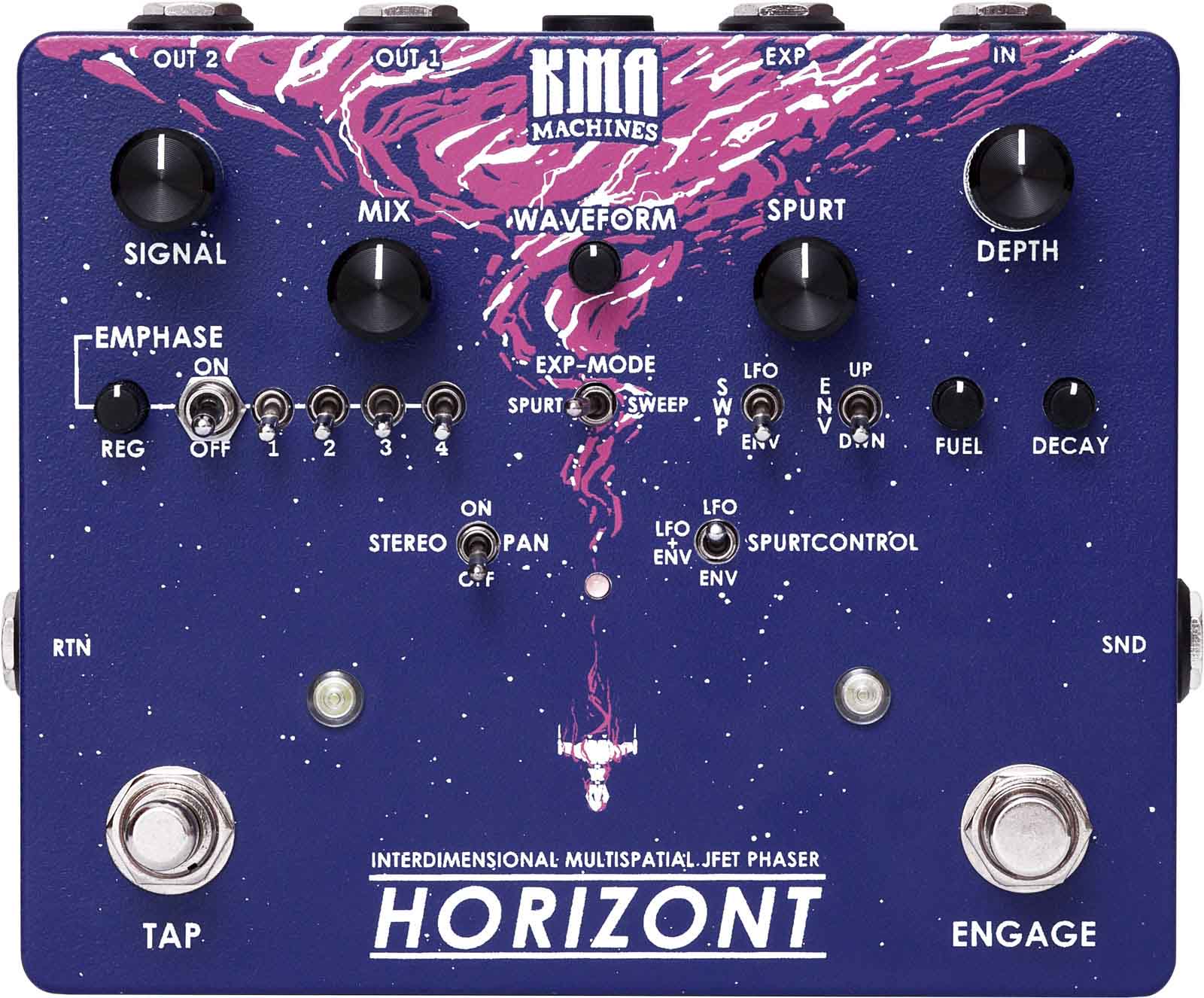


With the Horizont, KMA Machines takes the classic phaser concept and expands it into a much broader field: preserving the musicality and warmth of an analog JFET circuit, while adding a modern control layer (digital LFO, envelope behaviors, routing options) that multiplies the possibilities. It retains the spirit of characterful phasers, capable of very expressive grain and pronounced resonances, but with a more "instrumental" approach: the Horizont responds to playing dynamics, locks to a tempo, and can become a full-fledged sound design tool.
The EMPH (Emphasis) mode perfectly illustrates this philosophy: it's not just about adding resonance, but about being able to feed the phased signal back into different stages to sculpt frequency zones, highlight a vocal quality, or trigger more extreme and experimental behaviors when stacking multiple feedback stages.
The Horizont is aimed at guitarists (and more broadly musicians using a pedalboard) who want a phaser that can do it all: subtle phasing to thicken a clean tone, wide movements for rock and psychedelia, rhythmic textures synced to Tap Tempo, and soundscapes for ambient, post-rock, electronic, or experimental music. In the studio, it becomes an excellent stereo movement generator and a design tool to bring life to static takes. Live, its control modes (envelope, expression, Tap Tempo) allow for a coherent and "playable" result, even when settings go far.
The required skill level depends on ambition: in simple use, inspiring sounds are quickly achieved. However, if you explore multi-stage EMPH and high regeneration settings, the Horizont becomes a discovery machine-with sometimes unpredictable behaviors, perfect for musicians who like the effect to be part of the performance.
The heart of the Horizont is a digital LFO offering eight waveforms (Ramp Up/Down, Sine, Triangle, Square, a sweep waveform, Sample & Hold, and a random slope covering speeds from about 20 seconds to 40 milliseconds). This waveform selection radically changes the feel under your fingers: from smooth and "liquid" movement to more chopped steps, including random trajectories ideal for organic textures.
The envelope generator is the other pillar: it transforms your signal into a control source and can modulate the LFO speed, or allow for a more "manual" and resonant phasing depending on switch positions. The SPURTCONTROL selector offers three behaviors: LFO (SPURT sets the speed), ENV (speed reacts to attack level), or LFO + ENV (SPURT defines a minimum speed and the envelope "animates" around it). To fine-tune the response, the FUEL (sensitivity) and DECAY settings adapt the envelope to your dynamics and instrument.
For real-time playing, you can connect an expression pedal or a 0-5 V CV source to evolve the minimum speed on the fly. The EXP-Mode switch also enables a manual phasing mode controlled by expression/CV or disables this control via the center position. Finally, a TAP TEMPO button is included to sync modulation to your song's tempo, a decisive advantage in live situations.
The Horizont takes the experience further with a stereo output and a STEREOPAN mode: synchronized to the LFO cycle, the signal is distributed between OUT1 and OUT2 for a particularly immersive panning movement. And if you set the MIX to a completely clean signal, the Horizont can behave like a tremolo in place, while retaining control and synchronization options.
Last key point: an effects loop (FX-Loop) placed just before the phasing line. The idea is simple and powerful: insert your "secret weapons" (drive, filter, pitch, delay, etc.) to craft a phaser that is uniquely yours. Add to this an increased headroom thanks to an internal voltage boosted to 18 V (from a 9 V supply), and you get cleaner and more stable phasing, even with higher-level sources.
The Horizont's sonic signature combines a rich and warm analog JFET phasing with a very modern sense of control. At moderate settings, it offers wide, "watery" movement with nice depth and good attack clarity. Pushing the regeneration (REG) and playing with the stages in EMPH mode, the effect becomes more vocal, sharper, and can shift to resonance-saturated textures, oscillations, and intentionally non-standard behaviors. The pedal responds strongly to dynamics (via the envelope), making it particularly expressive: you can go from a subtle sweep to a "speaking" phasing simply by changing your playing intensity.