30-day satisfaction guarantee or your money back
Call us : +33 257 880 074
 en
en 











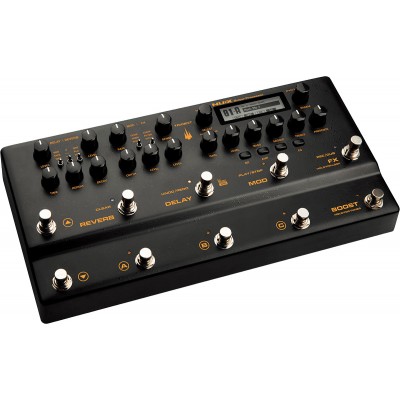
Designed as a spiritual successor to the Nux Cerberus, the Trident NME-5 clearly targets guitarists who want a multi-effects pedalboard capable of becoming the centerpiece of a modern setup. Its approach prioritizes playing and sonic coherence: a powerful platform with 2 DSPs, amplifier models worked out in detail, and ergonomics designed to chain rehearsals, studio, and stage without spending too much time in menus.
Its positioning is simple: to offer a high-end, robust, and intuitive multi-effects unit, flexible enough to replace a traditional pedalboard or integrate into a hybrid rig (amplifier, FRFR, mixer, audio interface), while maintaining a convincing touch response.
The Nux Trident is aimed at guitarists of all levels seeking a reliable and reproducible sound, from home studio to stage. With 27 amplifiers, an IR speaker section, and a complete set of effects, it naturally covers blues, rock, pop, metal, as well as more atmospheric genres (ambient, post-rock) thanks to modulations, delays, and reverbs.
In practice, it works equally well as a standalone processor connected to an FRFR speaker or mixer, or as an effects platform to pair with your amplifier via a 4-cable setup. You can also use it as a silent headphone solution or as a recording base thanks to its USB-C connection.
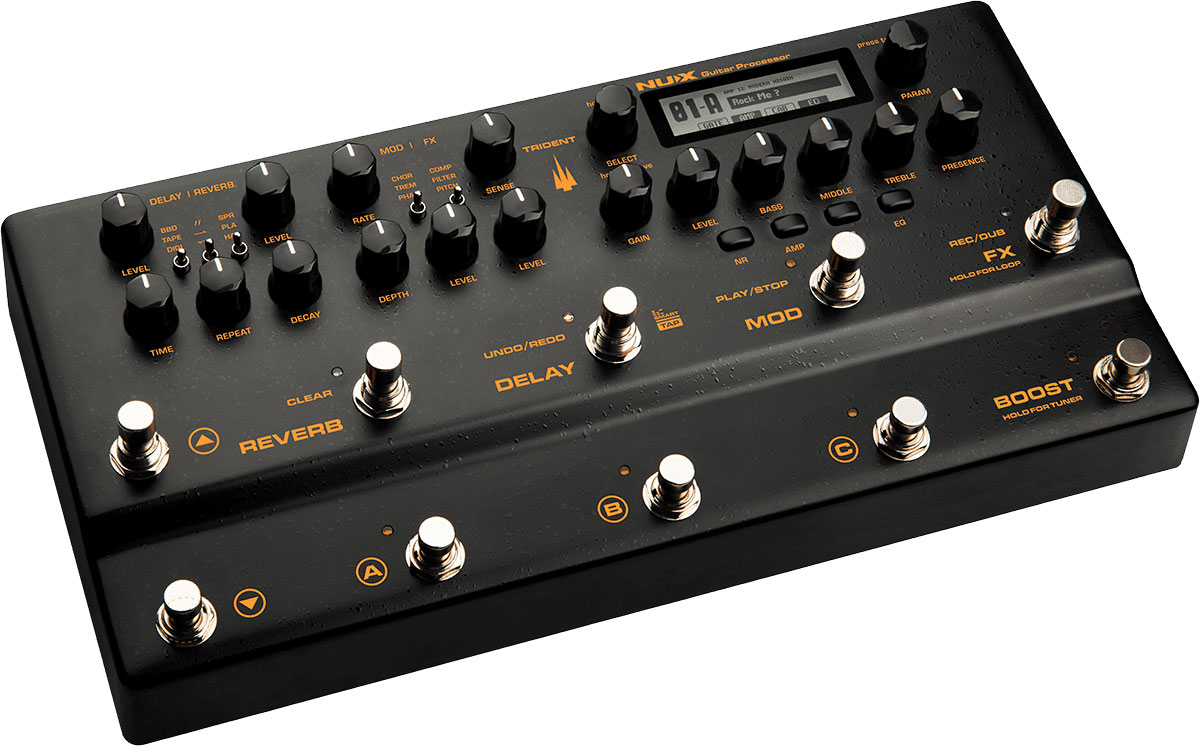
The Trident NME-5 emphasizes efficiency in real conditions. Its 10 footswitches allow quick access to banks and presets, control of effect blocks, and use of utility functions (tuner and looper). Editing is done via an LCD screen framed by two encoders, with a clear logic to build a preset as you would organize a chain of pedals.
The core of the system is based on 10 freely arrangeable blocks: NR, BST, EFX, AMP, CAB, EQ, S/R, MOD, DLY, RVB. The result: you can go from a simple and direct sound to more creative routings without losing ergonomics. The 30-second looper can be placed pre or post effects (useful for working on a sound or progression, then tweaking settings), and the Para. Follow function facilitates recalling favorite parameters and settings within your presets.
On the integration side, the Send/Return effects loop (series, parallel, branch modes) opens the door to hybrid rigs: inserting a favorite drive pedal, an external preamp, or placing a complementary multi-effects unit. The MIDI In/Out in mini-jack format simplifies setup control (scene changes, synchronization), and the USB-C serves as both an audio interface, connection to the software editor, and firmware update channel.
The TSAC-4K engine focuses on feel: attack, compression, grain, and micro-variations respond organically to right-hand nuances and guitar volume. You get airy and clear cleans, then dynamic crunches that retain chord detail, up to denser saturations with articulation designed for the mix.
The speaker section relies on 1024-sample IRs, complemented by 32 slots for importing third-party IRs: a real lever to customize your sonic identity (type of cabinet, more modern or vintage character, tighter or wider feel). The 3 mic simulations allow quick adjustment of the final color without complicating the workflow. Finally, the 109 dB dynamic range and 1 ms latency enhance the immediacy feeling, whether you play on headphones, live on stage through a mixer, or in recording.



 Certified
Certified
Certified
 Verified