30-day satisfaction guarantee or your money back
Call us : +33 257 880 074
 en
en 









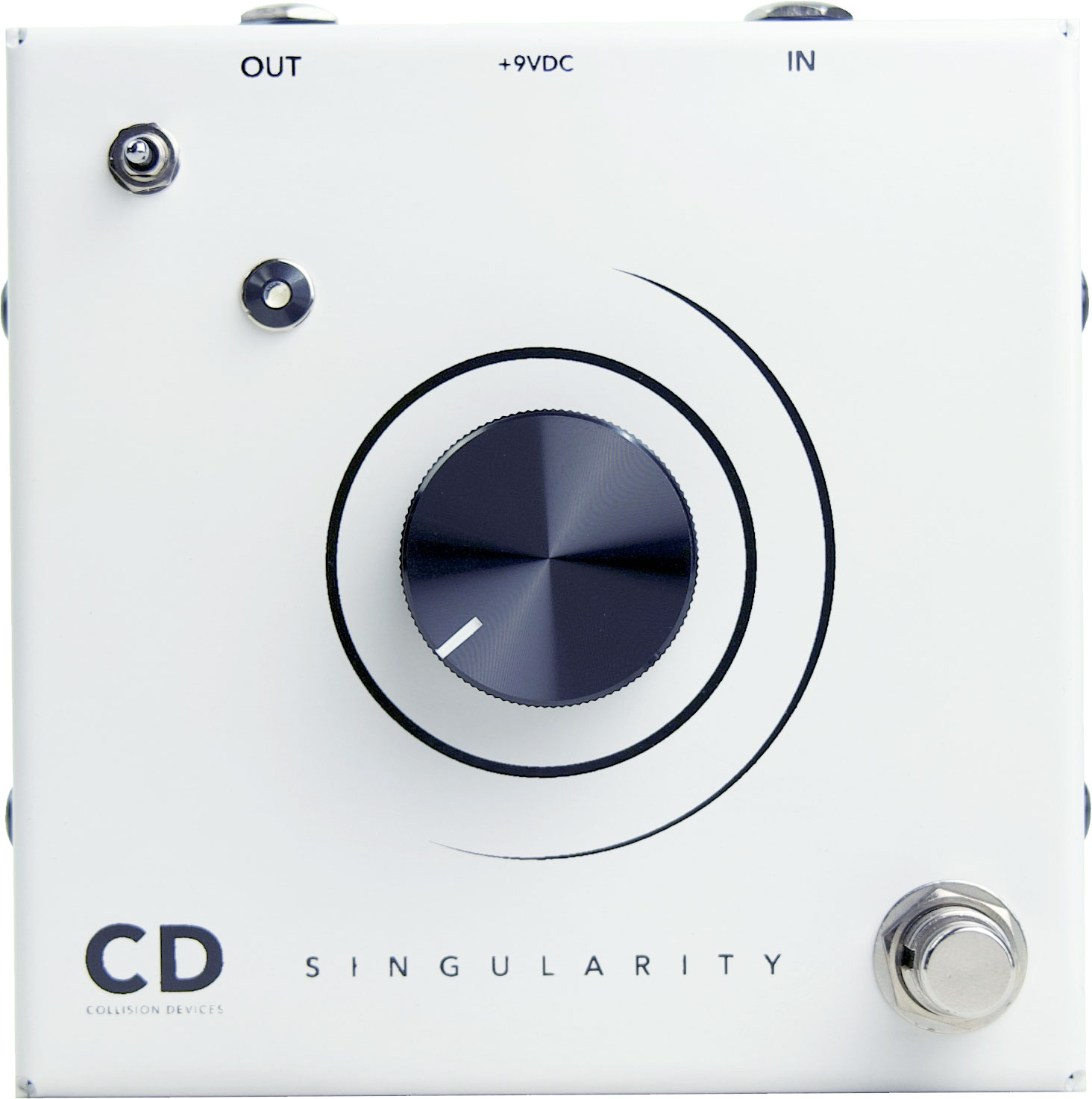


The Singularity takes the DNA of the fuzz from the Black Hole Symmetry and condenses it into a dedicated pedal: the same "one knob, zero distraction" approach, the same aesthetic, and above all the same sonic philosophy - keep it simple but go very far. Designed and manufactured in France, it is aimed at musicians who want a highly characterful effect, capable of transforming a guitar (or bass, or synth) line into raw, dense, and explosive material.
The Singularity is ideal if you are looking for a boutique fuzz without menus or settings: you plug in, activate, and sculpt by ear. It suits both intermediate and advanced guitarists who want a "one purpose" pedal to integrate into a pedalboard oriented towards rock, stoner, garage, punk, noise, industrial, shoegaze, or experimental music.
In the studio, it is perfect for layering dirty textures, doubling a rhythm part with an aggressive grain, or making a melody stand out with a saturation that has a very distinctive character. Live, its minimalist approach is an advantage: one level control, one filter switch, and you instantly adapt the fuzz's place in the mix depending on the amp, the venue, and the song.
The philosophy of the Singularity is clear: no gain, no classic tone control, no blend. The single potentiometer controls the output volume (the overall fuzz level).
The 3-position selector acts as a low-pass filter with three cutoff frequencies (1.5 kHz / 3.3 kHz / 16 kHz). This is the heart of the "smart setting": you choose how much treble and attack you let through, from the darkest and most compact to the most open and biting.
Regarding integration, the pedal is true bypass to preserve your signal when the effect is off, and the use of an isolated power supply is recommended for clean operation on a pedalboard.
The Singularity delivers a thick, saturated, and deliberately destructive fuzz, with a "wall" aspect that fills the space and a natural compression that makes notes more massive. The JFET input stage followed by silicon transistors provides a sharp attack and a grain that can range from rough to downright abrasive depending on your instrument and playing dynamics.
The low-pass filter radically changes the feel: in the 1.5 kHz position, you get a darker, more compact fuzz, perfect for thick pads and heavy riffs; at 3.3 kHz, the compromise is often ideal for rock and leads; at 16 kHz, the fuzz opens up and regains brightness, useful for cutting through a dense mix. By playing with your guitar's volume and pickup selection, you can go from controlled chaos to a more "articulated" grain without touching a forest of settings.